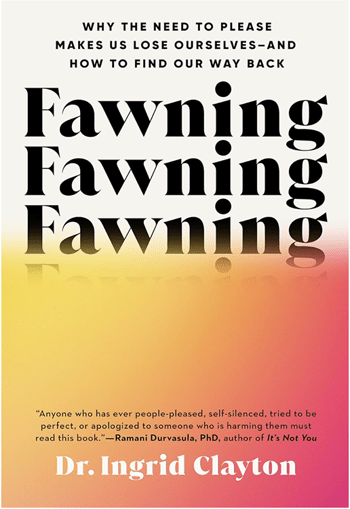
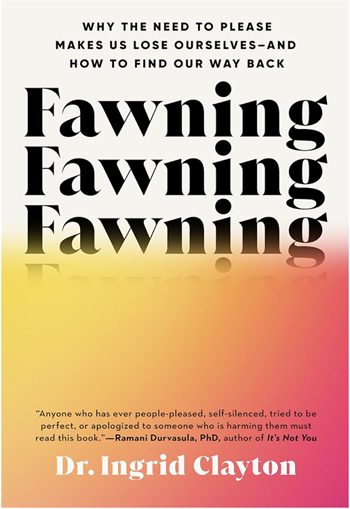
 Wed.,Jan.28th,2026 5:00 PM – 6:00 PM PT Registration is required for this free live private Zoom event.From a clinical psychologist and expert in complex trauma recovery comes a powerful guide introducing fawning, an often-overlooked piece of the fight-flight-freeze reaction to trauma—explaining what it is, why it happens, and how to help survivors regain their voice and sense of self.UCLA’s Friends of the Semel Institute for Neuroscience and Human Behavior at UCLA and the Resnick Neuropsychiatric Hospital Board of Advisors invite you to an Open Mind program with Ingrid Clayton, PhD, author of the best-selling book, FAWNING – Why the Need to Please Makes Us Lose Ourselves and How to Find Our Way Back. Nicole Presley, PhD, Ed.M, head of UCLA Counseling and Psychological Services (CAPS), will join Dr. Clayton in discussion. Most of us are familiar with the three F’s of trauma—fight, flight, or freeze. But psychologists have identified a fourth, extremely common (yet little-understood) response: fawning. Often conflated with “codependency” or “people-pleasing,” fawning occurs when we inexplicably draw closer to a person or relationship that causes pain, rather than pulling away.Fawning explains why we stay in bad jobs, fall into unhealthy partnerships, and tolerate dysfunctional environments, even when it seems so obvious to others that we should go. And though fawning serves a purpose—it’s an ingenious protective strategy in unsafe situations—it’s a problem if it becomes a repetitive, compulsory reaction in our daily lives. But here’s the good news: we can break the pattern of chronic fawning, once we see it for the trauma response it is. Drawing on twenty years of clinical psychology work—as well as a lifetime of experience as a recovering fawner herself—Dr. Ingrid Clayton demonstrates WHY we fawn, HOW to recognize the signs of fawning (including taking blame, conflict avoidance, hypervigilance, and caretaking at the expense of ourselves), and WHAT we can do to successfully “unfawn” and finally be ourselves, in all our imperfect perfection.BIOSIngrid Clayton, PhD, is a licensed clinical psychologist with a master’s in transpersonal psychology. She’s had a thriving private practice since 2009 and is a regular contributor toPsychology Today where her blog, Emotional Sobriety, has received more than 1 million views.Her best-selling memoir, Believing Me: Healing from Narcissistic Abuse and Complex Traumablends deeply personal storytelling with Ingrid’s knowledge as a trauma therapist and her latest book.You can find Ingrid on Instagram and Substack @IngridClaytonPhd or her website is www.IngridClayton.com.Nicole Presley, PhD, currently serves as the Senior Executive Director of UCLA Student Resilience and Mental Health Services. In her role, she oversees several programs including the following: Counseling and Psychological Services (CAPS), the campus counseling center, which offers mental health treatment, including crisis response, therapy, psychiatry services, and clinical coordination; the Resilience In Your Student Experience Center (RISE), a positive mental health space that offers programming, training, outreach, and drop in support; the Campus Assault Resource Education (CARE) program, which provides sexual harassment and sexual violence prevention and advocacy services; and Case Management Services for students in significant crisis.She co-chairs the students of concern committee (Consultation and Response Team) and is co-lead of the Mindwell Pod for the UCLA Semel Health Campus Initiative Center.Dr. Presley is a counseling psychologist who received her Ph.D. in Counseling Psychology at the University of Southern California. She received her Ed.M. from Harvard University Graduate School of Education and her B.A. in Psychology from UCLA. Her areas of interest include student resilience and academic success, particularly among students of color, African American family issues, sexual assault, and intimate partner violence issues.Dr. Presley is actively involved in the Organization of California Counseling Center Directors in Higher Education (OCCDHE). To watch videos of our past Open Mindprograms, |

 BKonthescene